Saturday, February 1, 2014

Brave Adventurer!

Valikorlia

   During the many, many years I grew up in my small town, my life was peppered with reading. During middle school I had read the first and second books of The Wheel of Time. In grade school, a teacher used to delight in reading us The Hobbit on Fridays before our parents came to pick us up; at an early age stories of adventure and daring were well-ingrained in my childhood.
   I tend to find it funny then, that as I grew older I tended to gravitate more away from epic fantasy and towards other genre of fiction, particularly pulp heroes and deconstructions thereof being among my favorite. That's not to say I don't have an appreciate for what the genre offers, merely my opinion has massively distanced itself from the general consensus. I hate Tolkien, and I hate when people try to talk to me about it at parties.

   If the The Legend of Zelda was inspired by Shigeru Miyamoto’s childhood being filled with him exploring caves like some sort of intrepid adventurer, than Zelda in regards to my childhood has come full circle.
   The Legend of Zelda was, at the very least, the reason for me to wanting to explore as a little kid. Growing up in an incredibly rural area meant I was surrounded by lots of countryside, but it was that game specifically that got me out in the world as a kid.
   My first real experience with roleplaying was watching my two older brothers and a ton of their friends lay the foundation for what would later be the longest campaign they ever played in Dungeons and Dragons it also had the effect of spurning on my early fascination with storytelling; and not just playing a role but being able to decide what that role was.
   Growing up in such a rural area might have made me predisposed to hiking and exploring. My favorite games tend to be things with more of a focus on exploration and experiencing an area than outright in-your-face challenge.
   I really mean it when I say rural. The town I grew up in is not unlike the small towns the protagonist of a road movie or some 80’s TV show where a guy is a cop and also a ninja might drive through and solve someone’s problem. It’s a very much one-note place, even today it’s become unfortunately more a tourist destination than anything else.
Legend of Xanadu II

   Videogames might have then, also inspired my disenchantment with growing up in a place like that.
The side-effect of the digital age is something both of my brothers and I talk about quite frequently.
We’ve had to deal with interconnection more than either of my parents did growing up. Many of the ways we started hearing about the outside world we’re very much double-edged swords. I was exposed to new opinions and ideas frequently, but I was also constantly aware of how other people had more, larger opportunities to grow.
   I didn’t ever even have a single art class to ease my frustrations with, or help curb my procrastination. I think back on it now and I realize it’s no wonder that I escaped more into roleplaying than I really did anything else. For a few hours a day I had an outlet where I could be someone else.
   A game called Valikorlia took up my days and nights, and definitely influenced the way I criticize storytelling in Videogames.
To start: it made me realize that in even the best roleplaying games, I’m still/always a part of a pre-set story path. Regardless of being the last Dragonborn or whether I’m forcing myself to play someones shitty D20-equivalent spinoff about whatever the hell a Grey Warden was supposed to be; I am still in a design of someone else’s narrative.
   I’m not asking to be able to abandon a galaxy and run off to play space pirate or anything; what I want is an experience that gives the player room to affect things.
In the simplest terms, Shin Megami Tensei has sort’ve played Wi this, whether you're a hipster teen saving the world or a moody..teen…again (always teens!) remaking it in his image. Along the way, the game is generally peppered with simple, dual option choices that have a great tendency to massively affect the flow of the game.
Shin Megami Tensei IV
    There’s a point In the latest entry in the game, Shin Megami Tensei IV, (itself worthy of an article) around midway into the game where you’re presented with a decision by an ally. Players familiar with the game will know what I’m talking about; it’s been the only decision I’ve experienced in a long time I had to make in regards to a digital world where I actually set my 3DS on my lap and had to think about it for several minutes.
   Another way I’ve started to look at this moment in relation to the story is it accomplished something many games can only claim to. It forced me to set aside the game world and examine my characters role in it from a position of that actual character, and what I was trying to accomplish.
Examining the story I’m presented with is another thing that doesn’t happen enough in RPG’s.
   GOTY-2012 darling Dark Souls makes the player do it without dialogue trees in the way it presents its general plot as a part of the world, and not as the world to exist as an excuse of the story itself.
Anyone whose ever played a tabletop or individual roleplaying game might be familiar with this feeling. When your group, or your future, depends entirely on a single action. It’s a feeling I think many games lose because they equate the idea of those decisions as being context-less and important in themselves. Everything becomes a yes no answer instead of letting decisions grow organically.
You are suddenly asked to make decisions. Asked to a fire a gun, instead of put in a situation where you can decide on your own terms to pull the trigger.
Katsuya Terada, Dragon Warrior

   Loaded under the pretense of the player being capable to decide which direction the story is going to go in, you’re spirited forward from set-piece to set-piece operating under the idea that what you do matters. Whereas the simple alignments of Shin Megami Tensei work for it’s black-and-white worldview, a lot of the problems other games have stem from the way players are rewarded or punished for those decisions. You’re expected to deal with a world that blurs moral lines but constantly stifled with a morality system that doesn’t. It, for me, leads the feeling of being forced into another persons story instead of being allowed to direct one.
   It seems in the realm of videogames, players are either transient ghosts or corporeal gods, never allowed to exist within the confines of the story nor acknowledge their role in it.
I have taken part in adventures, but seldom been allowed to experience one.


Saturday, January 25, 2014

You Should Be Reading....X-Men


   I’m not what you could call a ‘fan’ of Brian Michael Bendis. When he’s tackling a group like The Avengers, I feel that his approach to character dialogue often times doesn’t suit the less playful characters like Steve Rogers or Bruce Banner.
   Far from the first person to levy that criticism against the man, I’m certainly willing to admit that I do like humor and banter in my superhero books; it’s just that when that banter often times overpowers genuine character interaction I begin chomping my teeth and going into a kind of pubescent fit thinking “Christ can’t you fucks learn how to write an interaction that isn’t dripping in sarcasm.”
   More than that, I’d probably be more inclined to say I’m upset at the host of younger writers taking the Bendis approach to things and not understanding how to actually apply it thoughtfully.
So while the approach doesn’t work for your daily nine-to-five Avengers; it never entirely felt at home with a cast of characters like the X-men, especially over the last few years.
   If you haven’t been reading the X-men books (and I haven’t) you can definitely see that perhaps even more than the classic Days of Future Past that mutant-kind is basically settled into the idea of having an even worse future, just from catching up on the books through reading wiki.
   When you flip through the pages of Uncanny circa a few years ago and characters are engaging in light banter that wouldn’t be out of place in one of those YA Sci-Fi novels that are so incredibly god damned popular these days; it creates a bit of narrative dissonance when you realize the group of killers and members of a dying race are engaging in a little verbal sparring.
   Marvel isn’t above the lighthearted approach to their comics, and this isn’t really a take that towards the idea. There’s been a lot of success with Hawkeye recently, one of the best books they’ve come out with in recent years; it’s just that Bendis has always been better at writing teenagers, and most of the important X-men are all adults now.
   Arguably, it extends to even the more immature characters. Bendis is great when it comes to Spider-Man (though, he suffers from the all too common of making everyone sound the same) and characters like Kitty Pryde; who are willing to balance the seriousness of their lives with a little fun immaturity (not unlike most comic readers!)
   Off the top of my head, I know I was definitely like that as a teenager and most of the people I know below the age of 18 still certainly are, it’s not really something that changes with time.
After all, the characters in those awful movies where people go back to high school are usually able to get along so well because they’re still immature shitheads.
   This is where there would be an editor’s note rectifying that not all immature people are shitheads, that the two values are intrinsically related but not necessarily dependent on each other.
I’m my own editor though, so I’ll let the jokes about teenagers and comic fans slide.
   You can tell Marvel was thinking of a new way they could tap Bendis teen-YA centric writing while also giving fans what they want, and in a completely under-handed house of ideas way, driving home the “be careful what you wish for” stance they seem to take when it comes to unveiling new storylines.
Example: Since Jean Grey died originally and came back (which actually only happened a few times.) Fans have wanted her back.
    They’ve gotten Phoenix, the Goblyn Queen, I’m sure a robot or something in there to – the point is that people wanted Jean Grey back, probably the Jean Grey they’d grown up reading.
Fans we’re also clamoring for good-guy Cyclops again, after he went all Magneto while Wolverine took over Xaviers school.
    So, without a team of teens (heh) for Bendis to write and people wanting Jean Back, Marvel does the unthinkable in the first issue of All New X-men.
They bring the original X-men to the current Marvel timeline. Cyclops, Jean Grey, pre Kelsey-Grammar with hairplugs Beast, Archangel and Iceman.
    It’s pretty daring and not to mention seems like it’s a move meant to make controversy just like the recent Superior Spider-Man but it also works incredibly well as a jumping on point for the Marvel Universe.
    Out of the pages of the first few issues, you get to see the Marvel Universe as it is through the eyes of people that have yet to experience it. Bendis plays at having them retain their youthful optimism and balance it out with the core-casts anxiety of witnessing a world where for many of them, there was no happily ever after. A host of the drama comes from Jean Grey's role in a future where she's been dead for years.
    You see a young Scott Summers on the verge of dedicating his life to Xaviers dream look the jaded, cynical older Scott Summers in the eye and ask him how he could do the things he’s done.
   It’s smart, because the book shows you the things older Scott has done; it doesn’t try to cram too much into background details or text boxes. There are no “See Uncanny X-Men #456” boxes when a character mentions a Thing that happened. If it’s important, the book shows you, if it’s not, the story continues moving forward.
    I have to applaud the pacing Bendis keeps, the story is almost necessitated because of how unsure the X-men are in regards to their role in the future. It’s made clear that they have misgivings about returning to their own time, intending to set right the future they’ve come across.
  
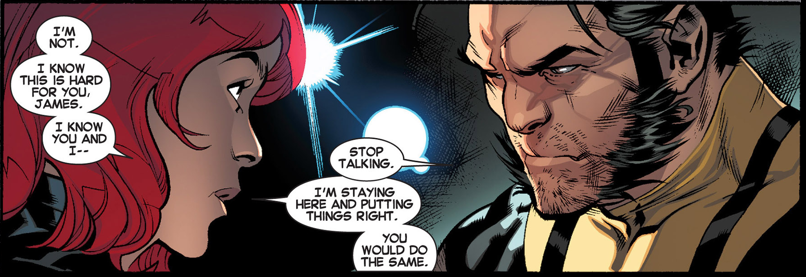
   Wolverine displays a kind of hilarious amount of hypocrisy; he plays an almost watchdog-like role, deriding them for them wishing to stay when he (and the rest of the x-men) have gone mucking about in the future before trying to ‘fix’ it. Wolverines shitty-dad attitude highlights the reason the book works so well: It’s repeating a tried and true X-men formula of the team trying to save a ‘bad future’ except in this case the bad future is the one we’ve been reading for years.
    All new X-Men is almost cartoonish in the way it depicts action. Stuart Immonen on art duties lends a vibrant, animated-series like look to Bendis’ feud-filled dialogue, there’s not a lot of scenes where the X-men aren’t bickering but Immonen does a great job of telling you about what the character feels just by the way they emote. 
   Probably his best work is drawing the young Jean Grey, who has to go from the quiet teenager she was in the original series into a fiery, stern adult before she's ready for leadership duties, taking over from a displaced and almost shy young Cyclops in a distinct role reversal from the 90's X-men that people probably remember Jean Grey from.
  He takes them through body language from the X-men you might have known into much deeper characters; they’re in a world that’s very much not ready for them and they aren’t ready for, so it’s fun to see the young X-Men effectively biting off more than they can chew and reacting in not only the way they talk to each other, but the way they carry themselves.

   All New X-Men, twenty or so issues in, continues to be a great way to jump into what Marvel’s doing right now with their Marvel NOW relaunch; while it's certainly not anything world-changing in the realm of comics, it's part of a more recent trend to only introduce hints of a larger comic-universe as they become relevant to the story. There are certainly more ways to tell the story, but All New X-Men is still a welcome addition to the Marvel Now lineup.


Thursday, January 16, 2014

Mess O' Effect


    The focus of first (and third) person shooters is generally, the way the gun ‘feels’ in the players hands.  It has to sound right when the muzzle initially flashes and fills someone across the room from you with holes, punching through their meaty torso as if they were cow hanging in a freezer somewhere. The way the slide kicks back and ejects the bullet casing, the player characters’ arms tense and  push back ever so slightly.
   Even DOOM did it, with the crunchy digitized sound effects and stiff reloading animations, it gave weight to an otherwise weightless experience and for a brief second you might feel like you actually have a piece of heavy metal in your hands.
   It is the same thing a game like Spartan: Total Warrior tried to replicate with a spear and shield, and Lords of Shadow tried to emulate with Gabriel’s trademark fighting style of Brutalswing, where every attack looked grim and epic, but had the meatiness of a vegan soufflĂ©.
   Out there, somewhere in the ether is a better analogy about bringing a feather to a pillow fight, but I don’t think a mention of Lords is ever complete without making fun of the game from how grim and brooding it constantly tries to reassure the player it is.
If Lords is a hollow experience and DOOM is a weightless experience, I think the cinematic-ness of a lot of first person shooters is rooted somewhere in there.
  Multiplayer focused titles have aren’t excused, switching from the bag of holding inventories of yore to two weapon gunfights with each player essentially in a played out match of quickdraw. Videogames ape cinema, but surprisingly not modern cinema; they ape the old Cowboy movies from a Hollywood now decades past.
   Guns too, in videogames function just as much as they often do in cinema. The weight is all in the action of firing or brandishing, and not in owning or having a gun.
The Guy Ritchie film Lock, Stock and Two Smoking Barrels treats firearms as a sort of plot device; the plot only moves forward because of the inclusion and possession of them. Videogames are hardly any different, and although stylistically the game I’m going to bring up is completely the opposite of that movie, the way it uses violence to motivate the story is almost entirely the same.
   Mass Effect is of course the trilogy that started in 2007, a sci-fi space opera reconstruction that collects the tropes tying together the Space Opera genre for the last forty to fifty years, combining influences of western sci-fi novels, anime and movies, blending them together in a (semi) cohesive mix.
   From the very outset in the game, specifically in regards to the first one, more important to you than any tool in your arsenal of dialogue options and negotiating skills is your firearm.
You will settle disputes violently, you will sometimes find yourself taken by a need to fuck shit up (with bullets) because you can.

    There are two choices of alignments in the game, which unlike the static bar of good-and-evil that Bioware offered you in its previous roleplaying titles, Mass Effect embraces a kind of dual-forked alignment system where Shepard is intended to not simply be quantifiable one or the other, but capable of making decisions that themselves can be “Paragon” or “Renegade”.
Bioware structured it this way to, I think, reflect the kinds of stories that Mass Effect took inspiration from.
    Paragon isn’t necessarily good and Renegade isn’t always evil, once you’ve committed to a choice
for either alignment, especially in regards to recurring characters, that choice will affect the future options you’re given. Alignment is more noticeable especially on an initial playthrough,
   It’s not uncommon to want to muck about with morals like some kind of bipolar reddit user given a position as the galaxies most unbecoming emissary of the human race, and notice later that a key ally treats you like a reprehensible jackass.
    Even as a Paragon what interests me the most is that you still receive just as many violent action choices as a Renegade; it’s just that as a Paragon you’re more likely to threaten “Evil” people (Noticeably, the rest of the cast doesn’t abide by the same alignment rules Shepard does and tend to fall more on one side of good or evil than the other).
    Violence continues to be an answer to most situations. Especially in regards to the games central villains. You can’t convince the Asari Matriarch to lay down her weapons in the first game any more than you can convince Saren at the end of it that his path towards genocide is wrong.
   If you can put a bullet in Saren’s head, than his goals will never come to fruition (which leads directly into the two sequels.)
The villains are always taken care of this way, with very few exceptions that are generally relegated to side missions. “I’ll let you live” is a choice the player seldom gets, and there are always negative repercussions for it.
   When the player levels up, there’s much more focus on combat skills than there are on improving negotiation skills with certain races or anything like that; the player receives one or two areas to improve regarding his people skills in comparison to the seven or eight ways given to murder opponents
   Regardless of the alignment choices you make in the game, as it asks you “A good natured, stern but softly spoken Paragon, or the violent, racist Renegade?” Either path you choose to walk, like a voice of the Paragon with the actions of a Renegade, or a stern manchild who gets upset when they don’t get their way; the character shoots the same.
   Once you pull the trigger for the first time in a situation in Mass Effect, there are no options for getting out of it. You cannot surrender, or offer to Parley with the enemy; there are never any options for negotiations given.
   In regards to death, the problem with the series (and really it could be argued, games as a whole) is there’s no thematic weight to the idea of killing someone, regardless of the implement used.
One of the only games I can think of that really averts this doesn’t even use it in regards to humans; the game is Shadow of the Colossus. The way the game highlights the death of the colossi individually is somber and melancholic; the orchestral fanfare fades and what was once a majestic giant falls into a heap of stone. 

   The player is given just enough time to reflect on it, it’s something that never happens once in the entire Mass Effect trilogy.
When an important villain in the first game is killed, the game just ferries the player to the next cinematic interaction, lost somewhere in the rapid cuts between people’s faces (it’s ‘cinematic’) the game loses all feeling and emotion it was building up to, so you can interrogate some fucker over where you’re supposed to be headed next.
    Mass Effect's commitment to making you feel like a super-cool space marine far overshadows any thematic resonance it strives to build, especially in regards to the first game.
The floaty, weightlessness of the combat is nailed down as the series continues to progress, creating a kind of parallel with how seriously the games begin to take themselves; yet never quite crossing the “David Cox” threshold of games that take themselves too fucking serious, thankfully.
   No matter how serious the games become, though, or how dire the situation is, the only choice you're ever really given is to keep shooting and move on.
-skeletons

Friday, January 3, 2014

"Cut" and "Take"


   I’m standing on a beach, looking at the waves roll over each other, endlessly pushing onto the shore and falling back into the ocean.
I, for obvious reasons, cannot feel the water on my feet, nor the breeze as it blows over the top of the infinite blue and licks against my cool, porcelain skin.
   I can hear a man approach me from behind though, while I am lost in thought.
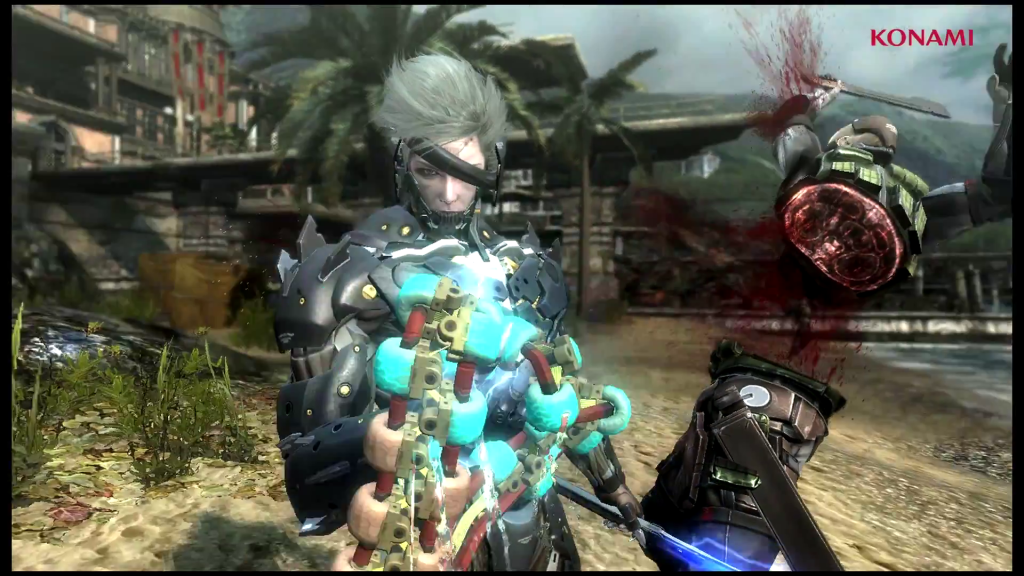
He swings his machete at my back, fully intending to jerk me away from thinking of the sea breeze or the sun beginning to set over the horizon. He expected to catch me unaware, but the second I see the red of his eyes out of the corner of my vision I have already begun to attack.
My sword passes through his ribs first, cutting deep into his heart and out the other side, splitting him in half.
  For a second, I feel something, or to put it in layman’s terms - I imagine the character I am playing as feels something. There is a deep stirring in my chest
when the blood spatter hits the screen, the character of “ZANDATSU” displayed over it (it’s Japanese for Cut-and-Take.”

   If we’re to speak of digital experiences, I’ve never seen the ocean before in real life.
Because of that, I’ve never quite understood the fascination with the ocean. You get told at a young age that it is impossible vast, yet at the same time it is succinct enough that it can be summed up in a photograph.
   For that reason, looking at the ocean in a videogame fails to excite me. I know what I am looking at is a clever facsimile of the real thing, stripped of the sound, the smell, the touch.
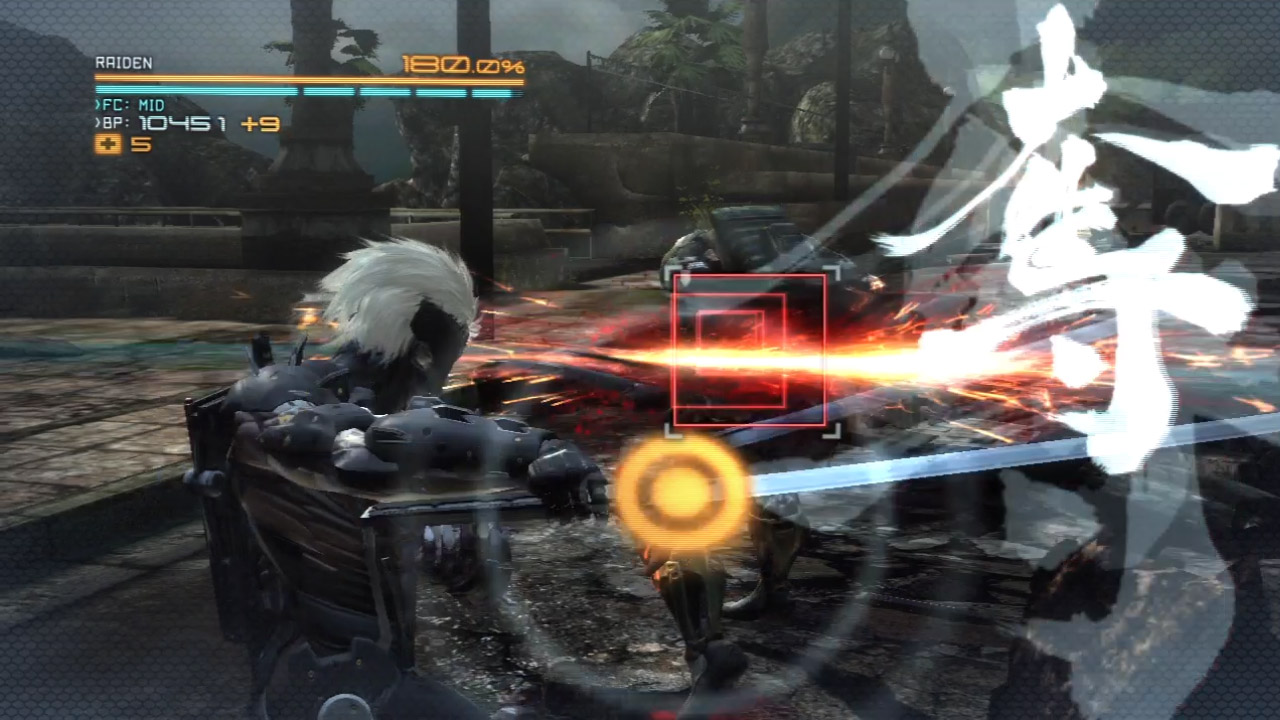
   When blood hits the screen in Metal Gear Rising, I have a stirring in my chest and I considered briefly upon playing it that perhaps it is the same thing someone feels when they look at a picture of the ocean after having seen it. I jerk back away from the screen, dropping my guard for a brief second. Another soldier takes advantage of this, I watch Raiden reel in much the same way I did and my life bar decrease.
   Frustration gets the better of me and I unleash a torrent of slices into the enemy that attacked me, finishing by literally disarming him. Videogames have made be believe I may have more familiarity with ending a life than I do with looking at something beautiful, I know this is wrong.


   In Metal Gear Rising, the core mechanic is that Raiden (the protagonist) can enter a kind of trance mode where time slows down. During this, the player has full control over the angle of his sword and many objects, especially enemies, can be bisected from just about any angle.
   Metal Gear Rising was the real Surgeon Simulator released in 2013.
   Second more important to that is that in the story of Metal Gear Rising, Raiden (the protagonist) goes off the deep end about half way through the story, entering a kind of bloodlust, berserker rage mode where he calls himself Jack The Ripper. Metal Gear Rising’s storyline, if you can’t tell, is pretty ludicrous; yet, there’s a type of story-gameplay cohesion that is out of this world compared to other action games released in the last two years.
   Metal Gear Rising, aside from the mechanics sort of borrowed from Devil May Cry (which form the basis for just about every modern action game) also borrows its sense of style.
Whereas Devil May Cry enforces you to be stylish, Metal Gear Rising doesn’t care.
Metal Gear Rising wants you to be Jack The Ripper.
It is an emotional game, not because of the story it tells, but because when it frustrates you, it causes you to react violently.
   I never feel Violent when I play Metal Gear Rising. I might get tense, or nervous as I watch myself get bodied completely free by Texas Senator but I never get violent.
I imagine Raiden doesn’t either.


   I’m somewhere on top of a building in Texas, now. It’s a city I’ve never been in, impossibly grand and large, yet I can feel neither the hot concrete on the bottom of my feet, the mist from the fountain I walked by earlier on my skin or the heat of the sun baring down on me.
Raiden and I are both waiting for the three soldiers in front of us to do something. It’s part of a learning experience, we both want to learn the timing of attacks necessary to correctly parry an oncoming assault, so he stands there while I idle my thumb on the joystick.
There’s that familiar red glint of the soldier’s eye.
   “Yes.” I tell myself. “Let me show you how it’s done.” Raiden springs to life, carrying his sword in front of him. A smattering of sparks appears on stage, there is a loud clang of steel against steel.
I split the soldier down the front of the head with my sword, carrying on to the one beside him.
Many games have graphic displays of violence in them, from the gore and mutilation present on bodies in Resident Evil to the corpses and bullet holes in Counter-Strike. Rising is different, because unlike those games I am the perpetrator of violence directly. I can equally choose to watch a lifeless ragdoll hit the ground and disappear as I can to watch the two halves of a man hit the ground.
The sense of accomplishment is not in watching a Style meter rise from Awesome to Stylish, it’s in knowing that I did that.

   I’m standing in a dry field in the middle of nowhere. The dust rolling off of the road is fresh, like someone just drove through. This is a place that’s familiar to me. I may not have ever stood on top of a skyscraper in the middle of a cluttered metropolitan city, or stood on a beach with the sand between my toes, but this is familiar. I can’t count how many times I’ve been here before, barefoot in the back of my parent’s yard in the middle of summer, or standing on a trail somewhere with a stick from the side of the road propping me up under the hot desert sun.
  There’s a warm breeze pushing at my back, reminding me to look forward to the next kill.
The distant hum of a motorcycle engine approaching tears the peacefulness of the old country road apart. I grip the handle of my sword, worried the sweat running off of my arm and into my palm might make me lose my grip.
This is no less make believe than standing on that road as a little kid, swinging a stick around.


-skeletons

LEARN


That’s the name of the game, or at least it should be
but what is it about Videogames that, unlike movies or literature,
different creators seem incapable of sharing techniques through?
One title might do something groundbreaking, only to see every copycat that comes
 
How else could this be worded

If you’re a novelist, a director, a musician, learning is the name of the game.
You start seeing what other writers, directors, guitar players that write similarly are doing
and how you can adapt those techniques to make them your own.
It’s how a genre like Hip Hop itself having established out of the late 70’s, can still be evolving and growing today. Different artists collaborate and learn from each other, musical techniques are established and experimented with.
The art form is allowed to be built upon, to grow.
On the other hand, if an art form is not allowed to grow, the entire community built around it
can be placed into a nightmare of creative-floundering, jumping from the one big idea to the next
hoping that it’ll be whatever it needs to set it back on the right course.
If you want a modern example of this happening; in the 90’s the mainstream Comic
industry faced a huge challenge with plummeting sales and stunted creativity.
“The Dark Age of Comics” wasn't just named for the amount of characters going ‘darker’ or ‘more’ realistic; it took its name from the literal Dark Ages for the lack of creativity between the biggest companies. The market for Superhero Comics was controlled by sales stunts like The Death of Superman that was little more than dramatic attempts to pull readers back.
Avid gamers reading now might realize that sounds a little more than familiar.
What happened to mainstream Comics in the 90’s had been an unwillingness to experiment and learn from each other: the head of DC comics was, at the time, convinced that the only way to do things was the DC way, and Marvel wasn't faring any better. They’d been playing the superheroes ball-game for the last 45 years spectacularly, only suddenly it wasn't working.
Generally speaking, superhero comics are so lowest-common-denominator that it couldn’t have been the actual subject matter at hand, but a lack of creativity lending to a homogenized set of stories being told for almost the entire duration.
Most popular characters that came out of 90’s Superhero Comics we’re the ones that went so wildly against the grain of what was expected, or outright parodied the genre conventions.
See: Deadpool (the landmark case of Wilson v. Wilson).

This year marks the seventh generation of consoles starting, which means examining the creative trends of the last seven or so years is more important than ever.
Perhaps more than any console generation, videogames have been tended to be more homogenized and ‘safe’. Cryteks Crysis series managed to create a market stranglehold through the efforts of probably paying off a bunch of journalists and being so safe and non-experimental that every single title managed to make even more sales than the ones before it. Responsible for pushing the industry one way or another, maybe, but other developers (like Infinity Ward and Bethesda) should be held to it much more. Infinity Ward hasn’t done anything besides be lazy and have appeal, so who else is there?


Crysis managed to add to the market stranglehold through the efforts of paying off journalists
and pitching itself so far below what you could consider the ‘common denominator’ that even the people that play it’s multiplayer professionally usually aren't even that good at other videogames.
Dominating the push for technology over creativity, the fad in the last seven years seemed to be Graphics with the common buzzwords from game enthusiasts being Resolution and Refresh Rate. Back of the box quotes praised production values over creativity, leaving titles like Nier to wallow in semi-obscurity.
A small set of bugs left behind from beta or because the developer couldn't afford better QA before being pushed to launch (see: Obsidian Entertainment) was a PR death-knell for a game.
Alpha Protocol an ‘Unpolished-Mess’ that was by all accounts ‘Riddled with Bugs’ is still considered so
despite the fact that the game did things with player-npc interaction and morality systems that not even Mass Effect has been able to figure out.
That resistance (inability?) to figure things out other titles definitely lead to the creative brick-wall that the last generation spent a good six years trying to hurdle over.
If you look at the impact of Grand Theft Auto on open world games, you’ll see a good example of this.
Comparing Grand Theft Auto IV and Driv3r or even open-world racing-games is eye opening.
While Grand Theft Auto is seen as laying down the genre conventions for fun open-world games, that’s the only thing other developers ever examine. You can even see it internally with Rockstar Games push to release for Grand Theft Auto V. The series has a strong timeline of design evolving over the years as each title incorporated, remixes or abandons things prior titles did.
A focus on storytelling and ham-fisted satire is evident, when Rockstar applied the same lessons to
L.A. Noire that timeline falls apart – you can tell by playing it that they were unaware of what lessons the genre they helped codify could benefit the game, but what lessons they might have learned from games they did not make. The game has a powerful narrative, but is set in an empty, soulless world.

When a developer does go out of their way to acknowledge that yes, another developer can in fact do something better than them, it’s, go figure, usually for the wrong reasons.
This goes beyond simply following trends, or even outright ripping off another developer.
Faux-learning is what happens when you get a lazy developer who knows people like one thing about A Videogame, so by that right Their Videogame needs to do the same thing often without knowing why.
One of the largest offenders is the Western World’s strange relationship with Shadow of the Colossus.
If there’s one thing that can be said about the game, it’s that it’s very much the antithesis of the way a lot of major studios handle design. A focus on barring the game down to only the strictest essentials required to tell the story presented effectively is the core tenant of the lead designer, Fumito Ueda’s, philosophy.

Yet, it still seems there’s a fault there because rather than applying any of the rules the team of Shadow of the Colossus did to design, what we instead was got a generation of developers applying aesthetic choices. The way the world was lit and traversed, perhaps inspiring more ‘realistic’ platforming than the PS2 release of Prince of Persia, itself also tragically misunderstood by developer and director alike.

To wrap up on a brighter note, though, we’re seeing a trend of Games Journalism moving away from valuing technical prowess when it comes to how journalists analyze and interact with popular titles.
Perhaps if we see ‘more’ of a trend of mechanical/design scrutiny, we’ll also see it employed as other studios take inspiration from earlier titles.


-skeletons 

Friday, October 11, 2013

BEYOND TWO SOULS


the whole time i was playing this, i wished i could walk out of the theater

Wednesday, October 9, 2013

COPS in GRAND THEFT AUTO (V)


   every encounter I've had with the police in real life, like something out of a book (or maybe a movie) has been exactly as uncomfortable
and stressful as you could probably imagine, and this is coming from someone who tries to abide by the law as best he can.
not being able to account for some people and situations I've found myself involved with, this also means that the few times a gun has been
pointed at me, a police officer was on the other side of it.
now, I've come to understand that having a cop point a firearm at you is probably one of the worst experiences someone go through, especially considering there's a feeling that a cop would be more willing to shoot you than say, a mugger, but a cop would also make you
lay on the ground for an hour. I recall a story about a man in Arizona being "subdued" which is the most passive term i think whoever handles law enforcement's PR could come up with for being assaulted, maced and handcuffed they could probably come up with.
it happened in the middle of a parking lot in the middle of an Arizona summer, which means the pavement is literally hot enough to fry a sausage on with your choice of oil, maybe olive?
the conclusion of that story was the man in question receiving second degree burns on his face, because the officer 'subduing' him held him against the concrete the entire time, becoming more rough with him every time he tried to keep his skin away from the concrete.
being sure at least someone out there is going to refer to a story like that as "an isolated incident" or "a violent exception" police brutality happens all over the world on a daily basis, and most examples of it go unreported.

in Grand Theft Auto, you can't report police brutality, and generally the only person you ever see it happen to is yourself.
unless for story specific reasons, no other bystanders get arrested, or even commit crimes unless you're squaring off with a rival faction/gang/group of caricatures and even then, their final judgement is a bullet or a baseball bat. (if you're me, it's a baseball bat, always.)

Rockstars role in the game industry as Satirists has given them an incredible weight to which they make their worlds realized,
a fascination with personal ego and vanity is played up the point it's so ridiculous it rings horrifying and true, and then Rockstar takes it a little further so it can be exploited as a sort of dark comedy.
Nothing in GTA is more gamified and exploited quite like the police are. Criminalization of a person is turned into a point-based wanted system that's a brilliant hallmark of the series and an easy way for keeping track of how dangerous you are at any given moment.
there's a certain thrill to having five wanted stars, a shitload of guns and the infinite tank of gas that every car in GTA is provided with, even more so by a decision to make the police in GTA cartoonishly aggressive and almost robocop-like in their pursuing of the player.
more interesting writers have done pieces on why the police act that way in the first place, so the history is sort of irrelevant as it pertains
to the theme here, especially in GTA V which is a game about people really trying to find their role in the world. that role is important in GTA, as it pertains to how the player interacts with law enforcement in the real world. JiHyun Kwan theorizes in her paper
on police brutality by using empirical data to analyze real-world cases and concepts of police brutality. One such area of her paper discusses a theory that, to summarize, infers that police brutality is the concept of role-taking on both an aggressor
and victim sides of conflict. In GTA, the police, ultimately, have no power of the player (good!) in the open world-nature of the game. they exist as a hindrance, not a power
that can actually control the player, so the player is free to 'push back' against them as much as they want. There is no role of 'force of power' and 'crimedoer' and we're going to use crimedoer here because that is [i]the best term[/i]. Without those roles, the player isn't [i]afraid[/i] of the police
yet, possibly part of Rockstars satire on Law Enforcement, they try anyway. police in settings of the GTA series are still seen as crimefighters by
the 'public' in the game world and rightfully, they are. generally; the player is not supposed to empathize with the police.


violent (often antisocial) crime is
seen as an ultimate liberation for the player, a way of completely destructing the status-quo of the world. exemplary of that is the tiniest scratch on a police car setting them off into a frantic chase down a highway, or a midtown shootout in the middle of a bustling city.
the player enforces his own status quo, so, in effect, the police now operate in a position as less-powerful than the player character
and allied factions. they pursue and enforce like you would expect a football-player to in a hit teen rom com from the nineties. almost robotic like
with a fascination with arresting the player character.
is this, in term, a caricature of the police by Rockstar, blowing their already violent and fascist tendencies wildly out of proportion
in response to the comic-book levels of violence the player engages in
the real question i guess, is "Are Rockstar Great Satirists" and if so, how do you effectively make the police even more gang and fraternity like than they already are in real life?


-skeletons